Possums in your roof: removal, the law, and proofing
Brushtails and ringtails are protected native animals. What your state lets you do, why exclusion beats trapping, and what a pro does.
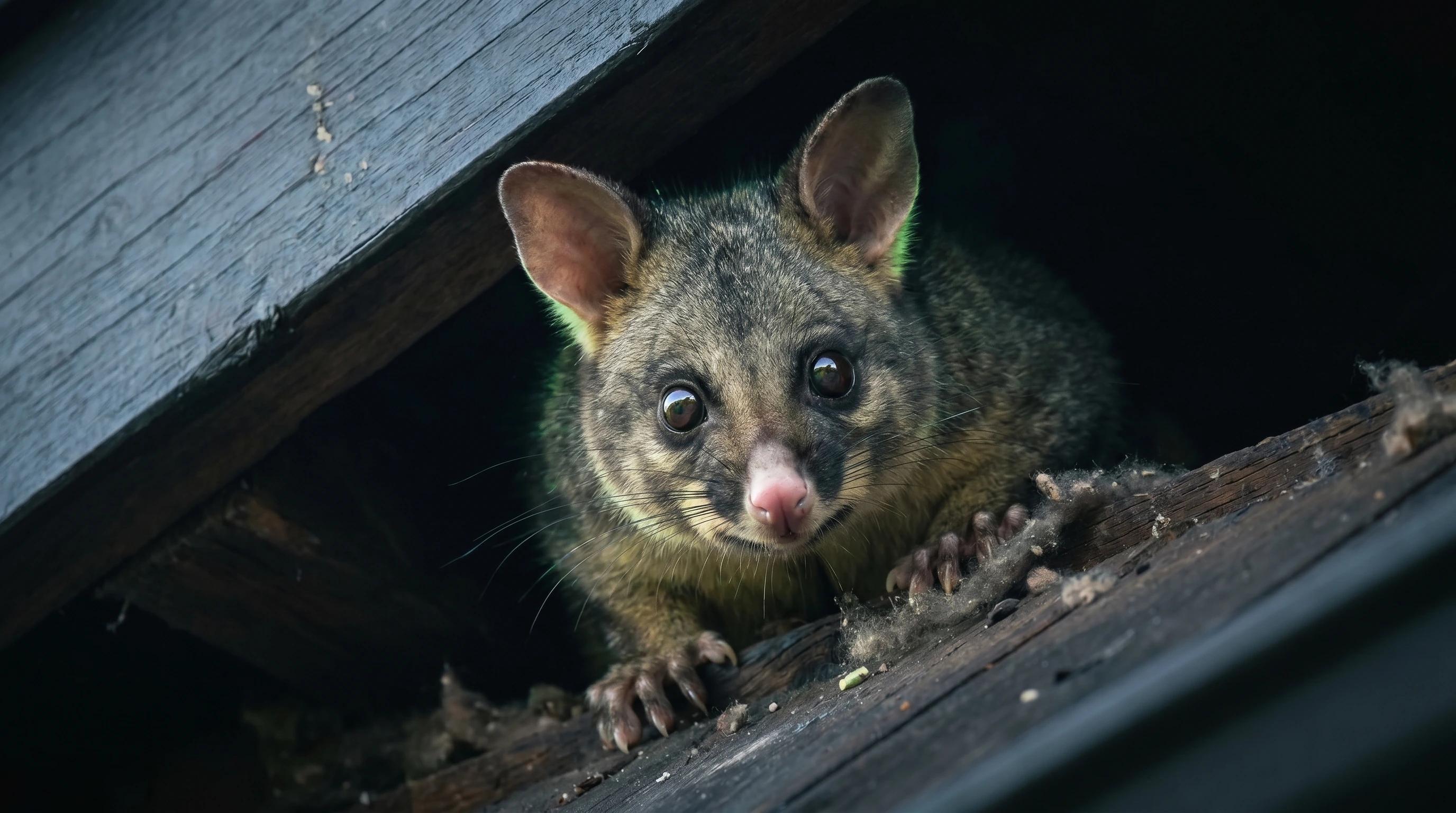
Which possum do you have?
Brushtail possum
Cat-sized (3–4 kg), grey or black, bushy tail, pointed ears. Solitary. Loud at night: thumps on the roof, hisses, growls. Strongly territorial: if you exclude one and another moves in, the new one may fight to take the spot. Lives 6–8 years in the wild.
Ringtail possum
Smaller (700g–1.1kg), light-brown / reddish, thin curled tail with white tip. Lives in family groups. Quieter than brushtails. Builds drey nests in trees more often than roof cavities, but will use roof space if available.
How they get in
Brushtails need an entry hole of about 80 mm (a gap in a broken eaves vent, missing tile, lifted ridge cap, gap where the roof meets a wall). They’ll also use overhanging tree branches or fence rails as a bridge onto your roof. Ringtails can squeeze through smaller gaps (~60 mm).
The legal process for removal
Australian wildlife laws differ by state:
- Wait for the possum to leave at dusk. They exit the roof to forage every evening (around sunset). They’re predictable: same time, same route.
- Check for young first. If you hear squeaking, or the possum doesn’t leave, call a pro or a wildlife carer before sealing.
- Seal entry points while it’s out. Don’t seal during the day. You’ll trap it inside, and it will chew/scratch its way out somewhere worse.
- Provide alternative habitat. A possum nest box on a nearby tree, positioned at least 4 m off the ground, can house the displaced possum so it doesn’t spend a week trying to break back into your roof.
- If exclusion fails: catch and release, by the rules of your state. In NSW only a licensed operator may do it, releasing the possum at dusk within 150 metres. In Victoria it goes back out on the same property within 50 metres. In Tasmania trapping needs a Special Purposes Wildlife Permit and is a last resort. In the ACT, possums are protected and it’s illegal for an unauthorised person to trap them.
What a pro does that you can’t (easily)
- Roof access and inspection: find every entry point, including ones you can’t see from the ground.
- One-way doors: a hinged device fitted over the main entry that lets the possum out but not back in. Stays in place for several nights, then sealed.
- Nest box installation: placed and oriented correctly for the local environment.
- Trapping where the law allows it: in NSW, catching and releasing a possum takes a biodiversity conservation licence, which licensed operators hold.
- Insulation replacement: possums urinate in insulation. After the possum’s gone, the contaminated insulation usually needs replacing.
What NOT to do
- Don’t kill or hurt the possum. Possums are protected under state wildlife law. In NSW even capturing one counts as harm under the Biodiversity Conservation Act 2016, an offence without a licence.
- Don’t use rat bait against a possum. Poisoning a protected animal is harming it, with the same legal consequences.
- Don’t trap and dump far away. Illegal and the possum will likely die at the release site.
- Don’t seal the roof during the day. Possum trapped inside will damage ceiling, chew wiring, urinate, and die in the cavity (then smell for months).
- Don’t use ammonia, mothballs, deterrent sprays. Negligible effect on a territorial possum. Possums hate the smell briefly and return after a day or two.
Cost
A licensed possum exclusion job in Australia runs $250–$600 for inspection + one-way door installation + sealing entry points + nest-box supply. Insulation replacement is extra and depends on the area and how contaminated it is. An annual roof inspection can catch new entry points before a possum finds them.
If the noise is just driving you crazy
Brushtails are loud. If you’re losing sleep, your options short of full exclusion:
- Trim overhanging branches: reduce roof access from neighbouring trees. The possum may move to a different roof.
- Possum nest box in your yard, on a tall pole or tree, 4+ m off ground. Often more comfortable than your roof void; possum sometimes moves voluntarily.
- Confirm it’s a possum. Loud thumping at night can also be rats running, birds in the gutter, or tree branches on the roof.